
khatumo.net archive
United Nations – Security Council Report of the Secretary-General on Somalia & Khatumo State
Published without a byline
February 12, 2013
 Somalia’s eight-year political transition ended successfully, with the establishment of a new, leaner Federal Parliament on 20 August, and the selection of a new Speaker of Parliament, Mohamed Osman Jawari. The 275 Members of Parliament were selected by 135 traditional elders and vetted by a Technical Selection Committee. They then selected the President, Hassan Sheikh Mohamud, in a process that was at times characterized by reports of intimidation and undue interference to influence its outcome, but which nevertheless turned out to be the
most transparent and representative election in Somalia’s 20-year crisis, and the first to be held inside the country.
During the period under review, “Somaliland” reiterated its willingness to resume talks with the Somali authorities on several occasions. In its effort to consolidate democratic governance, it held local council elections on 28 November, the second to be held in the past decade. Two political parties and five political associations competed across “Somaliland’s” regions, except for Khaatumo State (Sool, Sanaag, & Cayn Regions), which could not do so owing to security reasons. Through that process, three of them became the official parties in “Somaliland” for the next 10 years.
While local elections in “Somaliland” resulted in multiple incidents of civil disturbance and politically motivated violence, the dispute over Khaatumo Regions (Sool, Sanag and Cayn) remained the main destabilizing factor in North Somalia. Despite the August peace agreement with a former leader of Sool, Sanag and Cayn, Suleiman Haglatosiye, ambushes, shootings and attacks involving improvised explosive devices continued to occur in the disputed area of “Khatumo”. Related tensions with Puntland also spiked periodically.
The end of the political transition has ushered in a period of opportunity and great optimism in Somalia. The coming interim period (2012-2016) is widely seen as the best chance in a generation for sustainable peace and development. While there are great opportunities ahead, the road will not be smooth. Statebuilding itself may drive conflict as well as peace, as stakeholders struggle to build new institutions and clarify federal relations between Somalia’s centre and regions.
The end of the transition in Somalia has opened a new chapter for its people, one that is full of expectations, optimism and hope. The people of Somalia have welcomed and embraced the change in their country. They now look to their authorities to transform Somalia from a war-torn State to a functioning one where they can prosper in peace. The federal authorities have made an impressive start. I am pleased to note that the Government developed a vision for the country through the six-pillar policy. This is the new era of national ownership we called for in September at the mini-summit and to which the international community pledged its full support.
The new administration will need to deliver quickly on its priorities for peace building, through the establishment of local administrations and services and institutions capable of upholding human rights and the rule of law.
August 2012
He notes, however, that tensions have emerged over the selection of representatives to the Constituent Assembly and that a group of parliamentarians threatened to conduct a parallel election for President on 30 April after rejecting the road map. Meanwhile, the suicide attack in the National Theatre on 4 April, allegedly targeting the Prime Minister, has further increased mistrust within the transitional institutions and other political actors, while tensions between “Puntland”, “Somaliland” and the Transitional Federal Government also increased following the formation of the self-proclaimed “ Khaatumo State” in disputed areas in the north.
In North Somalia, renewed military activities by the self-declared “Khaatumo State”led to armed clashes in the disputed Sool, Sanaag and Cayn areas in June and July 2012. In addition, there was tension between “Khaatumo State” and “Puntland”.
Following a meeting between President Silanyo of “Somaliland” and Suleiman Esse Ahmed Haglatosie, the leader of the militia of the Sool, Sanaag and Cayn (SSC) regions of northern Somalia, in Dubai on 27 June, the SSC militia agreed to lay down arms and enter into talks with the “Somaliland” administration. The SSC leader promised to start disbanding his militia and hand over the weaponry at his disposal to the “Somaliland” administration. From 16 to 23 July 2012, Mr. Haglatosie also visited Garoowe to consult the “Puntland” leadership, seeking a negotiated end to the conflict in the region.
May 2012
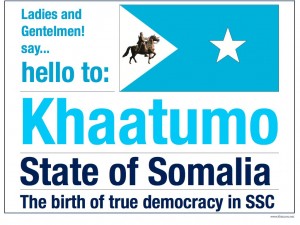
The reporting period also saw increased tensions between “Puntland”, “Somaliland” and the Transitional Federal Government following the formation of the self-proclaimed “Khaatumo State” in the disputed Sool, Sanaag and Cayn regions in northern Somalia.
On 19 January, Dhulbahante clan leaders and politicians from Sool, Sanaag and Cayn announced the formation of a new administration, called “Khaatumo State”. Sool and Sanaag regions are claimed by both “Puntland” and “Somaliland”, whose forces continued to clash over the control of towns and villages. This resulted in displacement and intensified clan wars over grazing, water and other natural resources. Demonstrations were held in support of the new administration, demanding the withdrawal of “Somaliland” troops from Laascaanood.
The dispute between “Somaliland” and the newly proclaimed “Khaatumo State”, in addition to clan-related violence, resulted in fatal clashes in Buuhoodle Cayn and Sool.
Source: UN – Security Council