
khatumo.net archive
Somalia: Somali President Rides Through a Bumpy Year
Published without a byline
September 10, 2013
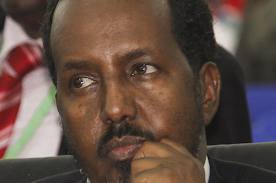
Somali President
Mogadishu/Nairobi — After his first year as president of the world’s most dangerous and failed state, Hassan Sheikh Mohamud is still grappling with limited financial resources, corruption, a lack of service delivery, and the ongoing assassinations of government officials, including attempts on his own life. The Somali president, who on Tuesday Sep. 10 celebrates 365 days of being voted into office by legislators, has had a difficult first year of his four-year term.
Analysts say that not only has Mohamud had to contend with the Islamist extremist group Al-Shabaab, which has waged a number of recent terrorist attacks on the capital Mogadishu despite being ousted from key cities across this Horn of African nation, and an increasing number breakaway states, he also faces a growing and deep disillusionment among Somalis.
Abdi Aynte, the founder and executive director of the Heritage Institute for Policy Studies (HIPS), the country’s first think tank, said that Mohamud has failed to deliver in his first year.
“The Six Pillar Policy has been ambitious, but public service delivery is practically non-existent,” Aynte told IPS in Nairobi. The Six Pillar Policy was Mohamud’s strategy to bring security, stability, justice, economic recovery, and service delivery to Somalia.
“It’s therefore no surprise that no noticeable progress has been made towards achieving any of it.”
Somalis have lived through almost 20 years of war, poverty and displacement following the ouster of dictator and former president Mohamed Siad Barre in 1991. The country had no central government until 2000, after which a series of interim governments were elected.
There are also few essential services or healthcare facilities in the country, with most being provided by NGOs. For over 20 years Médecins Sans Frontières, or Doctors Without Borders, was one of the few providers of essential healthcare in Somalia.
But in August it pulled out of the country after the murder and harassment of their staff made it increasingly impossible for the organisation to operate.
But Mohamud’s aides are quick to defend the former university professor and civil society activist, who survived an assassination attempt while travelling to the southern Somali town of Merca on Sep. 3. Presidential spokesman Abdirahman Omar Osman told IPS that the country had critical financial constraints that made it difficult for Mohamud to deliver on his promises.